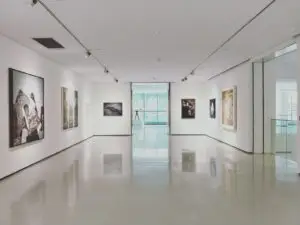
Artists often imagine a juror studying every entry in isolation and asking a single question: “Is this good art?” That image is understandable, but it leaves out most of what actually makes a juried decision difficult. A selection has to satisfy the rules of the call, hold attention on a screen, make sense beside other work, and fit the number of available places. The final list is not simply a ranking of talent.
The quick answer
Jurors usually look for a combination of eligibility, visual clarity, artistic intention, distinction, and fit. The work must survive each stage. A compelling idea cannot rescue an unreadable image, and technical polish cannot create relevance to a call that the work does not genuinely address.
This is good news, even though it may not feel like it. It means rejection is not a final verdict on the quality of your work. It also means you can improve an application without changing who you are as an artist.
Judging is not one decision
Most juried programs contain several decisions hidden inside one final result. First, the organizer confirms that the entry is eligible. Next, the juror encounters the work visually. Then the entry is compared with other submissions. Finally, the juror or curatorial team has to build a coherent group from a limited number of places.
That sequence matters because different parts of your submission become important at different times. Images often do the heavy lifting early. Statements, dimensions, installation notes, and biographies may become more important once the work is under serious consideration. NYFA’s application guidance similarly notes that images commonly lead the first round while supporting materials are often consulted later.
A juror is not only selecting individual artworks. They are often building an experience for a viewer. Two strong pieces may compete for the same visual role in an exhibition. A quieter work may be selected because it creates needed contrast, expands the conversation, or makes the overall group feel less repetitive.
The five passes an entry must survive
Every organization uses a different workflow, but the following five-pass model is a useful way to understand what can happen behind the screen.
Pass one: the eligibility gate
Before taste enters the picture, there are rules. The artist may be outside the geographic area. The artwork may be too old, too large, unfinished, previously exhibited when new work is required, or submitted in an excluded medium. Files may be missing, mislabeled, or impossible to open. In physical exhibitions, installation limits can remove work that the venue cannot safely display.
This pass can feel bureaucratic, but it protects the fairness and practicality of the call. CaFÉ’s guidance to organizers emphasizes clearly stating eligibility, accepted media, dimensions, selection timelines, and notification procedures. Artists should treat those details as part of the artistic opportunity, not as fine print.
Pass two: the immediate visual read
The first visual encounter is fast. That does not mean careless. It means jurors are usually viewing many submissions, and the eye begins forming questions immediately: What am I looking at? Where is the visual center? Can I understand the material, scale, and surface? Is the file accurate enough to judge?
A strong first read is not the same as being loud. Quiet work can be exceptionally arresting when the image is clear and the choices feel deliberate. The problem is not subtlety. The problem is ambiguity created by glare, weak cropping, a distracting room, inaccurate color, or a composition that collapses at thumbnail size.
Pass three: sustained attention
After the first read, the juror looks for reasons to stay. This is where intention, specificity, and control matter. Does the work reward a second look? Do the formal decisions support the subject? Is the piece relying on a familiar effect, or has the artist made the idea particular?
Technical skill can support this pass, but skill alone is not the whole test. A highly polished image may feel generic. A materially rough work may feel completely resolved because its texture, scale, and construction are essential to what it is saying.
Pass four: comparative distinction
Juried selection is comparative by nature. Your work may be evaluated beside pieces with similar palettes, subjects, formats, or emotional tone. The question becomes less “Is this competent?” and more “What does this contribute that is not already represented?”
This is why familiar subjects are not automatically weak, but they do need a point of view. A flower painting can be selected over dozens of flower paintings when its scale, atmosphere, structure, material handling, or conceptual frame creates a distinct experience.
Pass five: final-program confidence
At the final stage, practical confidence enters again. Is the artist’s information complete? Do the stated dimensions match the image? Can the work be installed or presented as promised? Does the title support the piece rather than confuse it? If selected, is the artist likely to meet deadlines and provide publication-ready files?
For online exhibitions, this stage can include whether the image will reproduce well, whether the artist supplied usable links, and whether the work can be presented without extensive correction. Professional readiness does not replace artistic quality, but it can reduce uncertainty when several strong entries are competing for the last spaces.
Think of the jury process as a chain. Your entry does not need to be the loudest at every link, but no link should create avoidable doubt. A clear image gets the work seen. A specific point of view gets it remembered. Accurate information makes it easier to select with confidence.
Why strong work can still lose momentum
Artists naturally look for one flaw after a rejection, but the reason is often relational rather than absolute. A piece can be strong and still be less useful to that particular selection.
| What happened | What it may mean | What to do next |
|---|---|---|
| The piece fits the theme literally | It may be accurate but predictable beside more interpretive responses | Ask what personal or formal tension makes your response yours |
| The work is excellent but unlike the submitted group | The juror may not see a sustained direction across the images | Submit a tighter sequence when multiple works are allowed |
| The image looks flat or small | Surface, scale, or detail may be disappearing on screen | Improve the primary photograph and use a detail view when permitted |
| Several similar works are already shortlisted | The final exhibition needs variety, not a duplicate role | Do not imitate trends; strengthen what is particular in your practice |
| The work raises practical uncertainty | Dimensions, display method, availability, or file quality may be unclear | Make the submission information easy to trust |
A juried result tells you what entered one final group. It does not tell you every work the juror respected along the way.
Scoring and selecting are not the same thing
Some programs use numerical scores. Others use yes, no, and maybe rounds. Scores can help organize a large pool, but a final exhibition is rarely created by copying the highest numbers into a list without discussion.
Imagine ten landscapes receive nearly identical scores. If only three can be included, the juror may choose the three that create the widest range of scale, mood, geography, or process. Another artwork with a slightly lower early score may enter because it opens a new conversation within the show. This is not necessarily inconsistency. It is the difference between measuring individual response and composing a complete program.
This also explains why trying to reverse-engineer a winning “style” is unreliable. Jurors change, submission pools change, and the needs of the final group change. The more useful strategy is to submit work that is recognizably yours and well matched to the opportunity.
How to prepare for the way jurors actually review
- Pass the rules test first. Confirm eligibility, date, dimensions, medium, image count, and display requirements before choosing work.
- View the image small. Reduce it to a thumbnail and check whether the structure remains readable without relying on fine detail.
- Build a coherent sequence. When submitting several works, make sure they deepen one another rather than proving you can do many unrelated things.
- Remove interpretive friction. Use accurate titles, dimensions, medium descriptions, and a statement that supports what the image already begins to communicate.
- Choose for this call. Your most awarded or most recent work is not automatically the strongest fit for every opportunity.
- Keep a submission record. Save the exact files, order, text, and results so you can identify patterns instead of relying on memory after a rejection.
Before submitting, ask someone to look at your image for ten seconds without reading the statement. Then ask what they noticed first, what material they assumed, and what they wanted to understand next. You are not asking them to judge the art. You are testing whether the digital presentation gives the work a fair beginning.
For the next step, use the five-part competition fit test to choose between several strong pieces, and review the guide to photographing artwork for online submissions before exporting your files.
How supporting text can break a close comparison
When two works hold similar visual strength, the title, medium description, and statement can help a juror understand which decisions are deliberate. The writing should not announce that the piece is profound. It should clarify the source, process, material logic, or question that is difficult to see in one image.
For example, “mixed media” tells little. “Graphite, erased family photographs, and wax on salvaged ledger paper” reveals a material relationship the image may only suggest. Precise information can deepen the work without trying to control the juror’s emotional response.
One final perspective: jurors are also viewers. Give them enough structure to enter the work, but leave enough openness for discovery. An application that explains every possible meaning can feel as restrictive as one that explains nothing.
Common questions
Do jurors read the artist statement?
Often, yes, but the timing varies. In many processes the images lead the first review and the statement becomes more influential during shortlisting or close comparisons. Write it to clarify the work, not to explain away an image that is difficult to evaluate.
Do jurors care about an artist’s exhibition history?
Some calls are anonymous or image-led, while others consider professional history as part of readiness or program fit. Read the criteria. A modest biography is not automatically a disadvantage when the work and application are strong.
Should I submit work similar to previous winners?
Use past results to understand the organization’s level of presentation and breadth of taste, not as a template to copy. A repeated imitation is less distinctive than a well-prepared entry grounded in your own practice.
Sources consulted: NYFA guidance on application review and writing about artwork; CaFÉ guidance on transparent call requirements and jury processes.
Submit with a clearer strategy
Explore Meridian’s current artist opportunities, with transparent requirements, selection details, and benefits listed before you apply.
View Current Opportunities